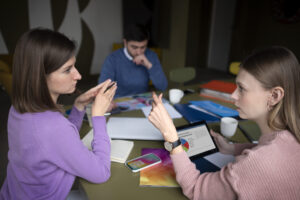
Trust is no abstract notion. Trust is what binds all successful teams together. The only instance when other aspects get better for a team, be it communication, making decisions, or production, is when team members become so comfortable in voicing their thoughts and opinions, own up, ask for help, and even argue without reservations.
But achieving such an atmosphere is not an easy task by any means. This is precisely what this article is all about – finding out what lies beneath building trust at work, how significant it will be in 2026, and certain habits to adopt going forward.
Why Trust at Work Is a Business Imperative
Before getting to the “how,” it helps to understand the real cost of low trust.
As noted by the results of PwC’s 2024 Trust Survey, even though 86% of business leaders say that there is a great deal of trust among employees within the organization, only 67% of the employees express similar sentiments, resulting in a difference of 18%. And while the said discrepancy was already wide, it is also increasing over time.
On the other end of the spectrum, the evidence for high-trust workplaces is equally compelling. Based on the Great Place To Work’s 2025 analysis of the Fortune 100 Best Companies to Work For, high-trust organizations generate 8.5 times higher revenues per employee than the entire US public market.
When organisations invest in the conditions that allow people to build trust at work, they are not just improving morale; they are building a measurable competitive advantage.
What "Trust at Work" Actually Means
In most team frameworks, trust gets reduced to reliability: “I trust that she will meet her deadline.” That is useful but incomplete.
The latter and stronger kind of trust is what Patrick Lencioni describes in The Five Dysfunctions of a Team. He terms it “vulnerability-based trust” – that is, a condition wherein team members are comfortable in admitting their own faults, asking for help, giving constructive opinions, and assuming positive motives from each other.
This is the core of the Five Behaviors theory, which identifies trust as the first and fundamental part of teamwork. Without this component, any actions that would be taken based on constructive controversy, commitment, accountability, and accomplishment would be jeopardized.
It is difficult to create vulnerability-based trust among colleagues in the workplace because professionals grow and succeed in their careers through the development of specific characteristics. In other words, competition, independence, and image maintenance are highly valued. As Lencioni puts it, “Successful people have learned how to defend themselves against attacks to their reputations.”
The Link Between Trust, Team Cohesion, and Psychological Safety
Trust does not exist in isolation. It is deeply connected to two other dynamics that shape team performance: team cohesion and psychological safety at work.
Cohesion, in essence, refers to the extent to which team members are connected and are working towards a common goal. It is possible that all the members of a team might share some views on the matter but the idea of cohesion entails the freedom for people to be able to argue without feeling threatened. This is made possible only through trust.
Psychological safety at work is the term used by Professor Amy Edmondson who teaches at Harvard Business School. This term refers to people feeling safe and relaxed while airing their points of view such that no harm is done to them as a result. The key element of psychological safety at work, according to Project Aristotle conducted by Google, which is probably the most quoted study of effective teams, is psychological safety at work.
Trust, team cohesion, and psychological safety at work are interrelated concepts. The first enables the other two whereas the last two reinforce each other.
Build Stronger Trust Across Your Team
Trust shapes how teams communicate, solve problems, and work through challenges together. Give your team a practical framework for building stronger relationships and achieving better results.
Talk to Our ExpertsHow to Build Trust at Work: 7 Practical Strategies
1. Model Vulnerability From the Top
Trust is an infection that normally spreads from the top down. When leaders recognize that there are things they don’t know, when they ask for feedback prior to decision-making, and when they accept their mistakes, they encourage everyone else on the team to follow suit.
One of the basic elements of the Five Behaviors Model is trust, which starts by being open. When leaders use information as an instrument, shift blame, or show infallibility, they slowly destroy trust.
2. Create Consistent Rituals for Open Communication
The creation of psychological safety within the workplace cannot happen through a single training session or the use of a value statement poster. Psychological safety must be created through the constant repetition of a safe environment when speaking out.
Some methods for doing this include conducting retrospective sessions in which successes and failures are shared without pointing fingers, creating one-on-one sessions where issues can be raised, and setting up feedback protocols in which feedback is explicitly handled.
With time, if such processes become part of a team development programme, openness becomes the norm within such a team.
3. Address Conflict Early and Directly
Unresolved conflicts will definitely be one of the fastest means of destroying trust in a team setting. As soon as team members sense that the subject under discussion is being avoided, they begin wondering what’s actually happening.
A very important step towards building a successful team is learning how to manage conflicts effectively. This basically means being capable of distinguishing between personal conflicts and intellectual conflicts, which will build trust when managed well.
4. Follow Through Consistently
Trust is built in small increments over time. Every time a team member does what they said they would do, by when they said they would do it, they make a deposit into the trust account. Every unmet commitment, however minor, makes a withdrawal.
This is particularly important in hybrid and distributed teams, where visibility is lower, and assumptions are more easily made. Building trust at work in these environments requires deliberate over-communication, not under-communication.
5. Invest in Structured Team Development
Ad hoc team-building rarely moves the needle. What works is structured team development that gives teams a shared language and framework for understanding their dynamics.
One of the most popular models for developing team trust is based on Lencioni’s findings and is known as The Five Behaviors model. This framework helps teams evaluate their current state regarding all five factors: trust, conflict, commitment, accountability, and results, and plan actions accordingly. Whenever the Five Behaviors model is applied in the process of team building, trust can be developed in an organization repeatedly, not in one-time activities.
6. Get to Know Your Teammates as People
Establishing psychological safety amongst people one doesn’t know very well at work becomes an uphill task. Understanding their communication style and the manner in which they like to work also plays an important role in developing goodwill when the going gets tough.
It is not necessary that socializing be enforced for this purpose. Simply beginning a discussion or a session with a non-business-related question or even giving a few minutes to recognize a personal achievement of the member helps build this human component very well.
7. Acknowledge and Reward Honest Behaviour
How a team responds to vulnerability determines whether they will see more of it. When someone admits a mistake publicly, and the response is problem-solving rather than blame, it signals to everyone else that honesty is safe here.
Managers who want to build trust at work should actively recognise when team members exhibit these behaviours, such as asking for help, admitting uncertainty, or raising an uncomfortable truth. Recognition does not need to be formal; even a simple acknowledgment in the moment reinforces the norm.
Team Cohesion Is Built in the Everyday Moments
One of the most common misconceptions about team cohesion is that it is built during annual off-sites or team retreats. While those moments matter, they are not where trust is actually forged.
Team cohesion is an aggregate of hundreds of small exchanges: How the team deals with failing at a task, how the manager deals with being asked a stupid question, and how employees interact with each other while dealing with deadlines. All these small things add to or subtract from the trust balance account described by the Five Behaviors model.
Building trust at work, therefore, is less about dramatic gestures and more about sustainable habits. When teams commit to a few key behaviours, assuming positive intent, addressing problems directly, and following through consistently, team cohesion grows organically.
The Role of Psychological Safety at Work in Team Performance
In Amy Edmondson’s study, it comes across very clearly that psychological safety is no longer a “nice to have” concept. It drives business performance.
Teams that score higher on psychological safety in the workplace are much more inclined to bring forward their mistakes sooner, meaning that the problems can be sorted out quickly. They are also able to share more information between different teams within the organization, resulting in well-informed decision-making.
This particular study’s findings correlate well with the theory of “The Five Behaviors.” In theory, trust is placed at the very bottom of the pyramid. It is important because one must create a trustworthy environment where people can freely express themselves.
Building trust at work is, in essence, building the conditions for psychological safety at work. The two cannot be separated.
Read More – Five Dysfunctions of a Team: Lencioni’s Model to Developing Trust, Accountability, and Cohesion
Final Thoughts
Trust is not a team trait it is a team practice. It does not arrive fully formed when the right people are in the room. It is built, slowly and deliberately, through the choices teams make every day about how they communicate, how they handle failure, and how they treat one another under pressure.
Whether you use the Five Behaviors model, invest in structured team development, or simply commit to a handful of the habits outlined above, the path to stronger team cohesion and genuine psychological safety at work begins with one commitment: to build trust at work as if it were as important as any other business outcome. Because it is.
FAQs: How to Build Trust at Work
Trust accumulates gradually through interactions. There is no set period of time because it relies on many factors, such as the experience and communication culture of the group, as well as the style of the leader. Nevertheless, team development programs based on the five behaviors concept may speed up the process.
But it involves effort. One must accept that something happened without understating the situation. The process of rebuilding trust within the team will take more time than when building it; however, the combination of consistent actions and communication will help achieve it.
Generally speaking, trust is all about having faith in one person’s integrity, dependability, and intentions. Psychological safety is a concept that applies to teams: it indicates how much safety the entire team feels when speaking out, making mistakes, and becoming vulnerable. Personal trust is an ingredient of psychological safety within a team setting.
The Five Behaviors model provides a structured framework for teams to assess and improve their trust levels through vulnerability-based practices. It gives teams a shared vocabulary, diagnostic tools, and concrete action items making it easier to build trust at work in a systematic, measurable way rather than relying on goodwill alone.
Team unity depends on one single factor – leadership. The behavior of a leader in terms of displaying vulnerability, communication transparency, and consistency in demonstrating integrity will influence the rest of the team members. On the other hand, any form of leader's behavior, which involves hiding things, being accountable, or being defensive, will negatively impact the team unity irrespective of how close members are.
Trust-building is a much more deliberate process in virtual teams because informal interactions don't come about as easily. Examples of such activities are video one-on-one check-ins, open communication guidelines, recognizing team members publicly for their efforts, and other rituals fostering group cohesiveness despite the physical distance.