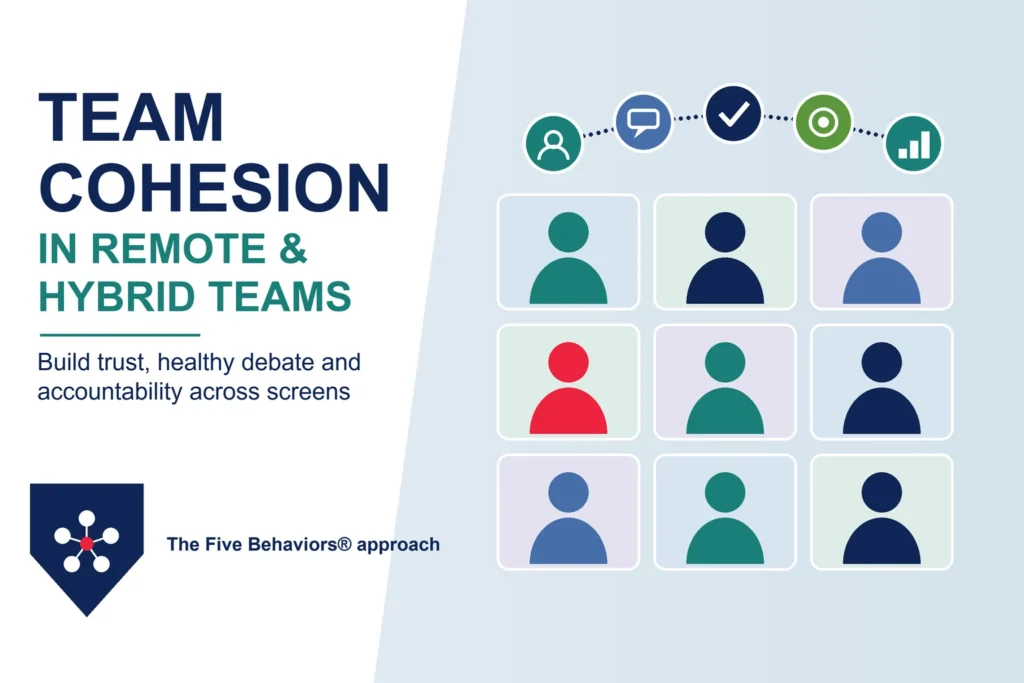
A remote team can have the latest tools, fast internet and a full calendar of video calls, and still not function as a team. The problem is rarely technology. It is behaviour.
When people are separated by distance and time zones, the small cues that build connection disappear: the quick hallway conversation, the reassuring nod in a meeting, the chat over coffee after a tough decision. Without them, cohesion does not happen by accident. It has to be built on purpose.
A useful lens for doing that is Patrick Lencioni’s model from The Five Dysfunctions of a Team, which describes five behaviours that cohesive teams share: trust, conflict, commitment, accountability and results. This guide explains why cohesion is harder to build remotely, what each of those behaviours looks like on a virtual team, and the practical habits that help distributed teams work as one.
Why Team Cohesion Breaks Down in Remote Work
Team cohesion is how strongly team members are connected to each other and committed to shared goals. It is the difference between a group of people who happen to work on the same project and a team that genuinely works together. (For a broader look at the concept, see 12 Ways to Improve Team Cohesiveness in the Workplace.)
In an office, much of that connection forms informally. Remote work removes most of those moments, and people can feel isolated even while they are busy and productive.
Gallup’s research makes this visible. Globally, 27% of fully remote employees report feeling lonely, compared with 20% of on-site employees whose jobs could be done remotely (Gallup, The Remote Work Paradox). This is not only a wellbeing issue. A person who feels disconnected is less likely to ask for help, admit a mistake or challenge an idea, and those are exactly the behaviours teamwork depends on.
Virtual teams also face some specific obstacles:
- Fewer informal touchpoints: Relationships form in unplanned conversations, which rarely happen on scheduled calls.
- Text-heavy communication: Tone gets lost in chat and email, so small misunderstandings grow into friction.
- Invisible effort: Colleagues cannot see each other working, which breeds assumptions about commitment.
- Meeting fatigue: Back-to-back video calls leave little energy for honest, deeper discussion.
The goal is not to recreate the office online. It is to deliberately build the behaviours the office used to create for us by accident.
What Cohesion Looks Like on a Remote Team
The traits of a cohesive team are the same whether people share an office or sit in five countries. What changes is how those traits show up on screen:
- Openness: People admit mistakes and concerns on a call or in a team channel, not only in private messages.
- Healthy debate: Disagreement happens in the meeting, where everyone can hear it, rather than later in side chats.
- Clarity: Every call ends with a written note of what was decided, who owns it and by when.
- Shared accountability: Peers follow up with each other on missed commitments, without waiting for the manager.
- Collective focus: Shared goals and dashboards matter more than individual metrics or departmental wins.
These traits map directly onto the five behaviours below, which give remote teams a sequence they can learn, measure and practise.
What Changes for Trust, Conflict, Commitment, Accountability and Results When Teams Go Remote
Lencioni’s model is usually drawn as a pyramid: each behaviour depends on the one below it, so a team that lacks the foundation cannot sustain anything above it. (For the full model, see 5 Behaviors of a Cohesive Team: A Guide for Team Leaders.) Here is how each level plays out when the team works remotely.
Trust: Being Vulnerable Without the Hallway Moments
Trust is the base of the pyramid. Here it means vulnerability-based trust: being comfortable saying “I was wrong”, “I need help” or “I don’t know.” On a virtual team this is harder, because colleagues see only a small window into each other’s working lives. Leaders can go first, for example by admitting a mistake in a team call or asking for input on a decision they are unsure about.
Conflict: Breaking Artificial Harmony on Calls
With trust in place, teams can engage in productive conflict: open, passionate debate about ideas, plans and priorities, not personal friction. Many remote teams fall into artificial harmony instead. Nobody objects on the call or in the group chat because everyone wants to stay polite and move on. Counter it by actively asking for disagreement, inviting quieter members to speak, and using anonymous polls. A useful team norm is “silence does not mean agreement.”
Commitment: Ending Every Call With a Written Decision
When people feel their views were heard, they commit to a decision even if they argued against it. In remote work, ambiguity is what kills commitment. End meetings by writing down what was decided, who owns each action and the deadline, then share that note so everyone works from one version of the plan.
Accountability: Peer Follow-Up Across Screens
Once the team has committed, members hold each other to it. On high-performing teams, accountability between peers is more powerful than accountability enforced from above. Remote teams can support it with visible progress tracking, regular follow-ups, and clear expectations for response times and deliverables. Most important is a culture where peers feel comfortable raising a missed commitment directly.
Results: Shared Goals Over Silos
Collective results sit at the top of the pyramid: the team’s success is judged on shared outcomes, not individual recognition or departmental metrics. Distributed teams easily slip into silos, with each person optimising their own work. Shared dashboards and team-level goals, reviewed together, keep attention on the collective result.
How to Build Trust in a Remote Team
Because trust sits at the base of the pyramid, it is the most important place for any distributed team to start. These steps work well in virtual settings:
- Open meetings with a personal check-in: A two-minute non-work question reminds everyone that colleagues are people, not boxes on a screen.
- Share personal backgrounds: Simple exercises, such as where each person grew up or what their first job was, build familiarity quickly.
- Use behavioural profiles: Work-style assessments help people understand why colleagues communicate and react the way they do.
- Have leaders take the first risk: When a leader openly admits a mistake, it signals that honesty is safe.
- Encourage presence, not surveillance: Don’t insist on cameras; consistent, genuine participation matters more.
- Be consistent: Doing what you said you would, when you said you would, builds trust over time.
Teams often ask how to build trust when members have never met in person. The answer is repetition and intention. Trust grows through many small, safe moments of openness, and on a virtual team those moments need to be built into the team’s routine rather than left to chance. For trust-building beyond remote settings, see How to Build Trust at Work.
Why Cohesion Matters More for Remote Teams
Cohesion pays off on any team, but remote teams feel its absence faster. Cohesive teams make decisions quicker, waste less time on politics and recover from setbacks sooner.
Retention is one of the clearest outcomes. According to Gallup, 57% of fully remote workers globally are either actively looking for or watching for new job opportunities (Gallup, The Remote Work Paradox). Teams that build genuine connection give people a reason to stay.
For remote teams, the main gains are:
- Better decisions: Open debate brings more perspectives into every choice.
- Faster execution: Clear, written decisions mean less second-guessing between calls.
- Stronger peer accountability: Colleagues raise problems before they become serious.
- Higher retention: People are less likely to leave a team they feel part of.
- Better wellbeing: Connection eases the loneliness that often comes with remote work.
A Simple Self-Check for Your Remote Team
Understanding the five behaviours is the start; practising them consistently is what changes a team. A simple way to begin:
- Rate each behaviour. Ask every team member to score the team from 1 to 5 on trust, conflict, commitment, accountability and results, anonymously.
- Share the results openly. Discuss them on a call and find the lowest level of the pyramid, since the behaviours above it depend on it.
- Agree on two or three norms. Pick specific habits that address that gap, such as a written decision log or a “silence isn’t agreement” rule.
- Check again in six to eight weeks. Repeat the scoring and see what has moved.
If you’d rather have a certified facilitator run this with your team using a validated assessment, see our Five Behaviors® virtual team training.
Final Thoughts
Remote work hasn’t changed what makes a great team. What it has changed is how easily weak spots stay hidden, and how rarely they get fixed by accident. On a distributed team, cohesion has to be built deliberately, one behaviour at a time, starting with trust.
Teams that do this well find that being remote becomes just one detail of how they work, not the thing that defines it. Start with an honest look at where your team stands today, pick one behaviour to work on, and build from there.
Frequently Asked Questions
Remote work removes the informal moments where relationships form, such as hallway chats and quick follow-ups after meetings. Communication becomes text-heavy, effort becomes invisible, and video fatigue limits honest discussion. Without deliberate habits, people stay connected to their tasks but not to each other.
Leaders should show vulnerability first, open meetings with short personal check-ins, use work-style assessments so people understand each other, and consistently deliver on what they promise. Trust builds through many small moments of openness, and it deepens when people see that honesty is not judged.
Ask for disagreement directly instead of asking whether everyone agrees. Invite quieter members by name, use anonymous polls for contentious topics, and adopt a norm that silence does not mean agreement. Reserve time on the agenda for debate so it doesn't get squeezed out.
End every meeting by writing down what was decided, who owns each action and the deadline. Share the note in a common channel or document straight after the call, so everyone works from the same version and nobody has to reconstruct it from memory.
Look for disagreement happening openly in meetings rather than in side chats, decisions that stay decided, peers following up with each other on commitments, and team goals taking priority over individual metrics. A short anonymous survey on the five behaviours gives you a baseline to track.
Cohesive remote teams make better decisions, execute faster, hold each other accountable, report better wellbeing and are more likely to stay with the organisation.